

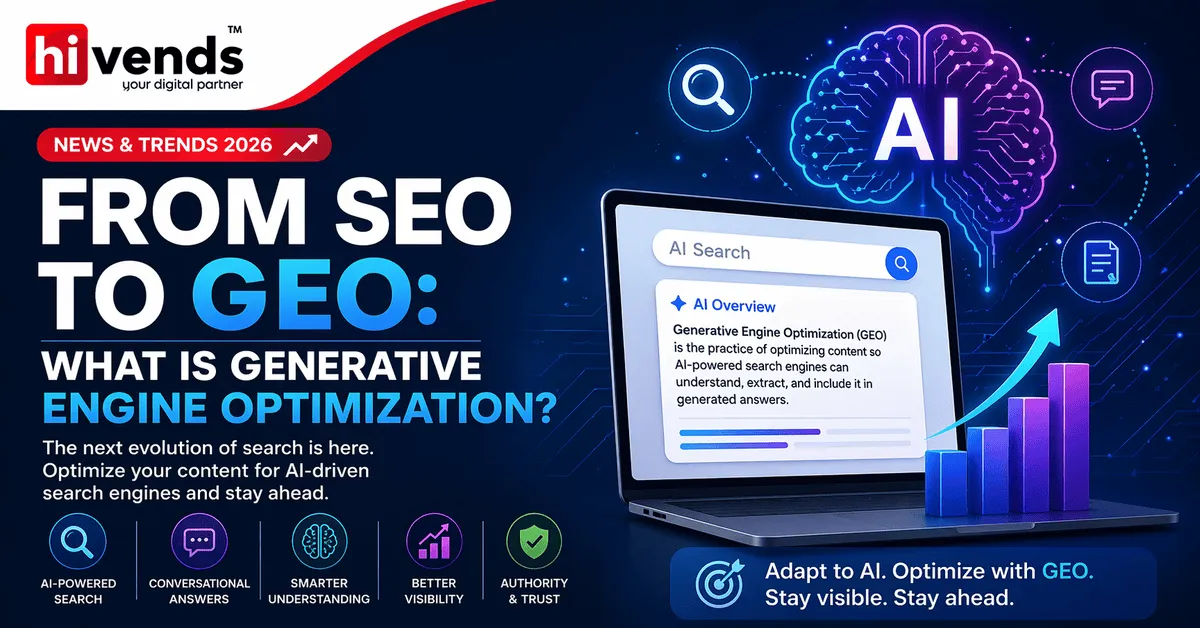
The digital marketing landscape for 2026 looks entirely different. For years, businesses have been using Search Engine Optimization (SEO) to increase their online visibility and drive organic traffic to their sites. Companies needed to know about Google and other platforms to get noticed on the internet.
With the evolution of search behavior, new approaches are needed to study user search patterns.
Today, instead of scrolling through search results as they used to, people turn to AI systems for answers instantly. and people are using ChatGPT and Google Gemini to search and consume information in new ways.
Digital marketing now includes a new concept called Generative Engine Optimization (GEO) which emerged from this transformation.
The Shift from Traditional Search to AI-Driven Answers
Traditional search engines operated by website crawling, which created an index of pages that search engines used to determine rankings through keyword assessment and backlink evaluation and technical performance analysis. Businesses created content, which they optimized to achieve top rankings on search engine results pages (SERPs).
The operation of AI-powered search systems has changed from their original design.
Modern search engines display results through their current system which shows direct answers instead of providing hyperlinks to external websites.
- Grasp user intent
- Look at the context
- Summarize the data
- Provide conversational responses
Users are increasingly getting answers directly, without having to click through multiple sites. This trend, sometimes called “zero-click search,” is changing the way businesses are seen online.
First place is no longer enough in this new environment. Your content must be formatted so that AI systems can understand and cite it.
What Is Generative Engine Optimization (GEO)?
Generative Engine Optimization (GEO) is the content optimization for understanding, extraction, and inclusion in the generated responses of AI-driven platforms.
While traditional SEO is concerned with improving search rankings, GEO is concerned with improving the chances of being cited or summarized within AI-generated answers.
In other words:
- SEO allows you to rank higher on your website.
- GEO helps AI engines select your content as a trusted source.
- This doesn’t mean the death of SEO. GEO is the next step in search optimization, not the other way around.
Why GEO Is Important in 2026
- The Rise of Zero-Click Searches: AI-generated summaries, which appear as search results, provide immediate answers to users. Users who search for information no longer need to visit websites, which decreases direct traffic but increases brand visibility because AI responses show their results.
- Search Behavior in Dialogue: Now users type in full, natural language queries, such as “What is Generative SEO?” And what’s the difference between GEO and SEO?: AI systems tend to rank content that is structured and provides direct answers to such questions highly.
- More Focus on Authority and Trust: Modern algorithms rate content on:
- Knowledge
- Precision
- Relevancy
- Dependability
- AI-generated answers tend to quote websites with strong Experience, Expertise, Authority, and Trust (EEAT).”
SEO vs. GEO: What’s the difference?
Classic SEO:
- Focuses on keyword ranking
- Optimized for search engine crawlers
- Success with click and traffic
- Heavy reliance on backlinks
- SEO gets you discovered.
Generative Engine Optimisation
- Emphasizes inclusion of AI responses
- Optimizes for AI language models
- Success based on visibility and brand mentions
- Looks a lot to authority and structured content
- GEO gets you AI-recognized.
The two strategies need to work together if digital success is to be long-term.
GEO Optimization Guide
Here are a few strategies for businesses looking to adapt to AI-driven search:
- Give clear definitions and direct answers: AI systems like short explanations that are easy to extract. Studies have shown that you’re more likely to be cited if you include short, clear definitions in your content.
- Build Topical Authority: Instead of publishing scattered blog posts, create in-depth content clusters that cover topics comprehensively. AI systems prefer well-developed knowledge hubs over isolated articles.
- Use Structured Formatting: Organize content with the following:
- Clear headings
- Bullet points
- FAQs
- Logical flow
Structured content improves readability for both users and AI systems.
- Focus on User Intent: Understand what the user truly wants to know. Rather than focusing only on keywords, create content that solves problems and provides meaningful value.
- Strengthen Credibility Signals
Include:
- Author information
- Real-world examples
- Data-backed insights
- Industry expertise
Trust signals significantly increase the likelihood of AI referencing your content.
Does GEO function as a replacement for SEO
GEO functions as an additional element that works together with existing SEO practices. Technical SEO continues to maintain its significance for
- Websites that require fast loading performance
- Websites that need to provide mobile access
- Websites that need proper content indexing
- Websites that require secure (https) connections
The AI systems require a strong SEO foundation because it serves as the primary method to detect your content.
The future is combining the two:
SEO is all about discoverability.
GEO offers AI visibility.
The Future of Search
Search is becoming more conversational, more personalized, and more AI-driven. Voice search, predictive queries, and AI-generated summaries will continue to mold how users get to information.
Businesses that will quickly go in for GEO optimization are more likely to stand out as trusted sources in the AI-ready space, potentially as a competitive advantage.
Those who are banking on old ranking tricks may find it hard to keep their heads above water as AI develops.
Final Thoughts
The development of generative engine optimization represents the future of digital marketing in an artificial intelligence-based world.
Success in 2026 will no longer depend on ranking positions because AI systems will determine content value through their ability to summarize and reference it.
The question businesses must ask today is simple:
Are you optimizing only for search engines—or also for the AI engines shaping the future of search?
